



The Industrial Revolution and the Dawn of Steam Power
The onset of the industrial era in the early 18th century was marked by humanity’s transition toward mechanical power. Pioneering efforts by figures such as James Watt and the Marquess of Worcester in the UK led to the expansion of steam power utilization and the initial design and construction of steam boilers.
Materials and Construction of Early Boilers
Early steam boilers were constructed as closed vessels made of iron plates, which were folded over and riveted together. These boilers came in various shapes, including spherical and cubical. They were typically mounted on brick walls directly over a fire, classifying them as “externally fired” boilers.
The Evolution of Steam Boiler History
In their early stages, these boilers provided pressures of approximately 1 bar, which met the demands of that era. However, they faced a critical flaw: the accumulation of scale and sludge at the bottom of the boiler—the only area where heat was exchanged between the flame and the water. This buildup caused the metal temperature to rise gradually, leading to deformation of the base and a high risk of explosion.
As industries demanded higher pressures, the manufacturing process underwent significant transformations. To achieve better thermal efficiency, the need for increased heat exchange surfaces became apparent. This led to the design of boilers featuring numerous narrow tubes through which hot gases flowed, surrounded by water. these designs offered higher efficiency within a more compact volume.
Modern Boilers
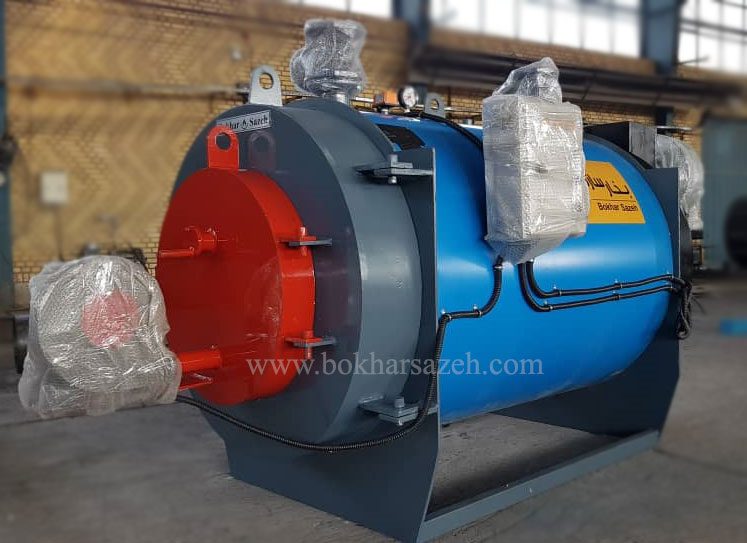
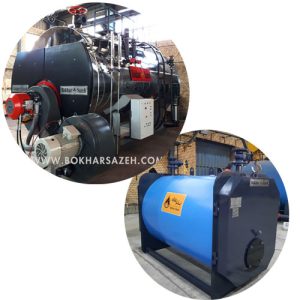
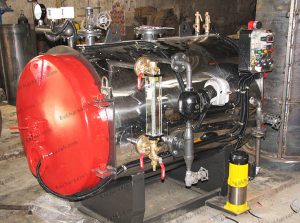
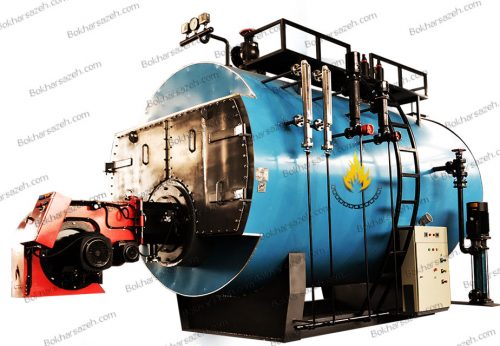
Today’s modern Fire-tube boilers with two or three passes are the evolved versions of those early designs. A major milestone in this evolution was the transition from Three-Pass Dry-Back boilers to Wet-Back configurations.
Three-Pass Dry-Back Boilers
In dry-back boilers, the ends of the 2nd and 3rd pass tubes are connected to a single tube sheet. Due to the extreme temperature differential between the combustion gases in the 2nd pass (approx. 1000°C) and the 3rd pass (max 250°C), the tube sheet undergoes severe thermal stress, eventually leading to leaks.
Furthermore, dry-back boilers require frequent insulation and maintenance of the refractory materials separating the passes, increasing operational costs and causing production downtime.
To resolve these issues, the Lincoln design was patented in 1935 for 3-pass boilers. This design eliminated the temperature differential stress by creating separate tube sheets for each set of tubes. Additionally, it converted the previously insulated surfaces of dry-back boilers into useful, heat-absorbing surfaces.
Wet-Back Boilers
The advantages of the Lincoln design led to the widespread adoption of Wet-Back boilers, a structure that remains the industry standard today. These boilers typically support capacities up to 4.3 MW.
Water-Tube Boilers
To achieve even higher capacities and pressures, Water-Tube boilers were developed. Today, a vast number of water-tube boilers with unlimited pressure ratings and high capacities—operating at 85-90% efficiency—are installed in large factories and power plants for energy generation.
Note: All boilers manufactured by Bokhar Sazeh bear the Iran National Standard mark. For consultation and price inquiries, please contact our sales department.
Safety Considerations: Steam vs. Hot Water Boilers
Unlike hot water boilers used in standard heating systems, steam systems operate at significantly higher pressures and temperatures, making them more hazardous for general use.
Steam systems carry a high risk of burns due to operating temperatures ranging between 160°C to 180°C. There is always a risk of explosion unless strict standards are followed and the boiler operates with a high safety factor.
Industrial Applications of Boilers
Steam boilers are essential for providing heat across various industries, including:
- Food Production, Greenhouses, Poultry Farms, and Mushroom Cultivation.
- Sterilization and Cleaning in hospitals, hotels, and restaurants.
- Heavy Industry: Crucial for paper manufacturing and plastics production.
- Power & Electricity Generation:
- Refineries and Power Plants
- Industrial Part Manufacturing
- Petrochemical and Chemical Industries
- Automotive Industry
- Dairy and Milk Processing
- Concrete Production and Curing
- Textile Industry (Yarn, Carpet, and Fabric Dyeing)
- Food Processing (Tomato paste, confectionery, chocolate, and bakeries)
- Cellulose and Paper Industry
- Rubber Manufacturing
- Meat Processing (Sausage production)
- Steam Saunas and Industrial Car Washes