


resin Water Softener
What is a Water Softener?
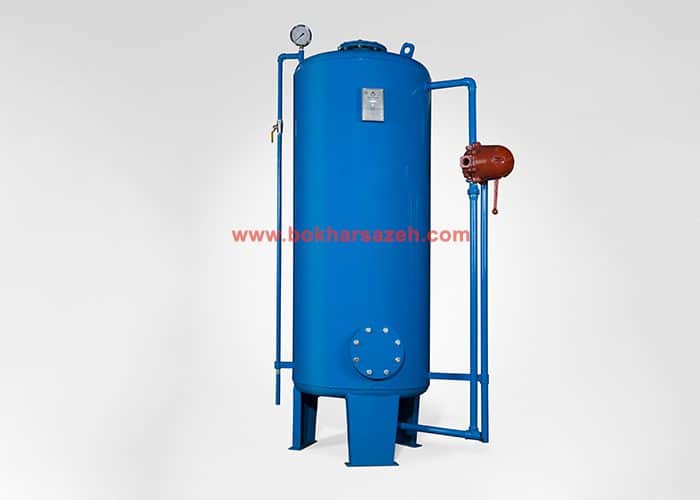
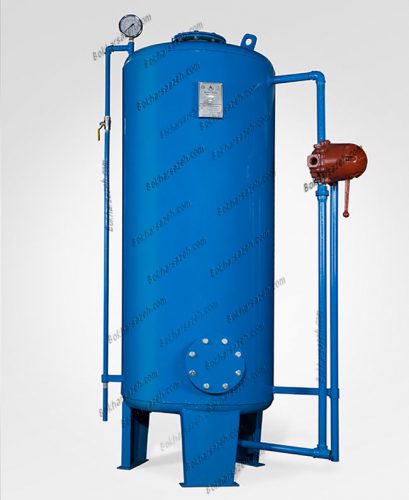
A water softener is a device that forces hard water (water containing high levels of dissolved minerals) through an ion-exchange resin under pressure.
During this process, hardness-causing minerals (such as calcium and magnesium) are removed, and the water is softened.
Water softeners are supplied with:
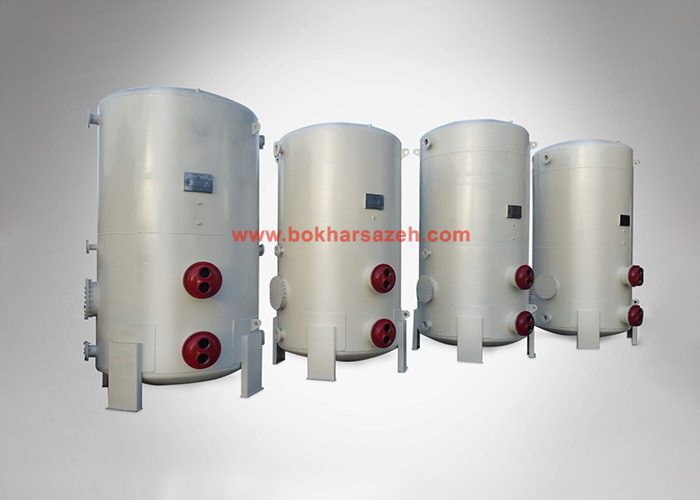
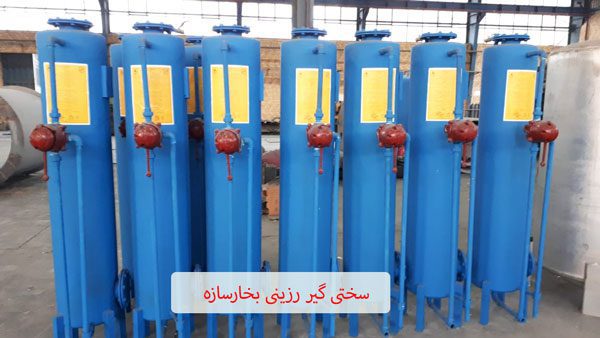
- A robust cylindrical steel vessel or FRP vessel
- Piping and connections
- A multiport control valve mounted on the tank
By removing excess ions from the water, resin (ion-exchange) softeners provide a stable and reliable method of water softening for industrial and HVAC applications.
Bukharsazeh Resin Water Softeners – Design & Construction
Bukharsazeh water softeners are resin-type, ion-exchange systems designed for long service life and reliable operation.
Main features:
-
Vessel material:
The main vessel is made of ST37 carbon steel, designed according to engineering calculations in compliance with ASME standards.
-
Internal coating:
All internal surfaces are derusted and coated with three layers of epoxy paint for corrosion protection.
-
External coating:
External surfaces are coated with primer (anti-rust) and oil-based paint.
-
Control system:
Available with semi-automatic or fully automatic control valves.
-
Nozzle protection:
To prevent nozzle blockage, the area between the nozzle plate and the resin bed is covered with coarse silica media.
-
Complete package:
Each unit is supplied with all required piping and fittings, a polyethylene brine tank, and high-quality cation exchange resin.
Types of Bukharsazeh Water Softeners
By operation mode:
- Fully automatic
- Semi-automatic
- Manual (on request)
By vessel material:
- Steel body
- FRP body
Standard Components of a Resin Water Softener
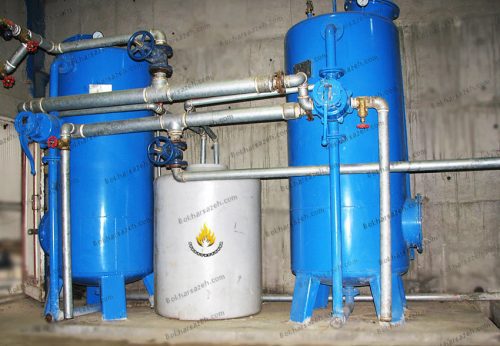
Each resin water softener typically includes:
- FRP or steel vessel with internal nozzles
- Manual, semi-automatic, or automatic multiport valve
- Cation exchange resin
- Brine tank (salt tank) with injector and brine line
A fully automatic resin softener removes dissolved mineral salts, especially calcium and magnesium.
Automatic and semi-automatic units work on the same principle; the difference is that in fully automatic models, all stages (service, backwash, brine draw, rinse) are programmable and do not require an operator.
Selection Criteria – How to Choose the Right Softener
Key parameters for selecting a resin water softener:
- Inlet water hardness (ppm)
- Type and capacity of resin
- Regeneration and rinsing cycle (time or volume-based)
- Service flow rate (inlet flow to the softener)
- Softener dimensions (diameter and height)
- Resin volume
- Vessel material (steel or FRP)
Manufacturers typically specify:
- Service flow rate
- Regeneration flow rate
- Fast rinse flow rate
Using these values, the required resin volume and vessel size can be calculated.
Operating Principle – Ion Exchange
Resin water softeners work based on cation ion exchange:
- The resin contains sodium ions (Na⁺).
- When hard water passes through the resin bed, sodium ions are exchanged with calcium (Ca²⁺) and magnesium (Mg²⁺) ions in the water.
- By removing these scale-forming ions, the tendency for scale deposition in boilers, heat exchangers, and piping is eliminated.
Regeneration & Backwash (General Description)
When the resin becomes exhausted (outlet hardness rises), it must be regenerated with brine (salt solution).
In regeneration mode, typically:
- Service outlet valve: Closed
- Inlet valve: Open
- Drain (wash) valve: Open
- Brine valve: Open
Brine from the brine tank is drawn into the softener and regenerates the resin, restoring its ion-exchange capacity.
Operation & Maintenance Tips
-
When to regenerate:
Monitor the outlet water hardness using the sampling valve and a hardness test kit.
As soon as outlet hardness exceeds the allowable limit, start the regeneration cycle.
-
Operating pressure:
During regeneration, ensure softener pressure is between 1.7 and 3.5 bar.
- Low pressure can disrupt brine suction.
- Excessive pressure can damage the multiport valve.
-
Brine concentration:
Brine concentration for regeneration should be about 10% salt.
Brine suction is factory-set, but can be adjusted if necessary.
Make sure the brine line is not clogged.
-
Pressure-reducing valve:
If inlet pressure exceeds 4.5 bar, install a pressure-reducing valve upstream of the multiport valve, or close the inlet valve before changing valve positions to prevent sudden pressure surges.
-
Salt quality:
Always use high-purity crystallized salt.
Rock salt or low-quality salt contains impurities that reduce resin life and prevent complete regeneration.
-
Water quality before softener:
Turbid water or water containing high levels of iron, manganese, copper or other heavy metals can foul the resin and reduce performance.
It is recommended to install a sand filter (pre-filter) before the softener, if needed.
-
Lubrication:
Once a year, lubricate the multiport valve through the gap between the cap and body using standard grease, without dismantling the valve.
-
Freeze protection:
Protect the softener from freezing conditions. Freezing may damage both the vessel and the resin.
Automatic vs Semi-Automatic Softener
-
Semi-automatic:
Backwash and regeneration are performed manually at regular intervals by the boiler room operator.
-
Fully automatic:
Backwash and regeneration are performed automatically, based on time-based or flow-based settings, with no need for an operator.
Applications
High water hardness is one of the main causes of scale formation inside:
- Boilers
- Heat exchangers
- Piping and HVAC equipment
For proper operation of boiler rooms and industrial heating systems, the use of a water softener is essential.
Call to Action – Contact
For technical consultation and quotation requests for resin water softeners, please contact our Sales Department:
- Tel:
+98 51 3845 0864 - Mobile / WhatsApp:
+98 915 167 8840
Reviews
There are no reviews yet.